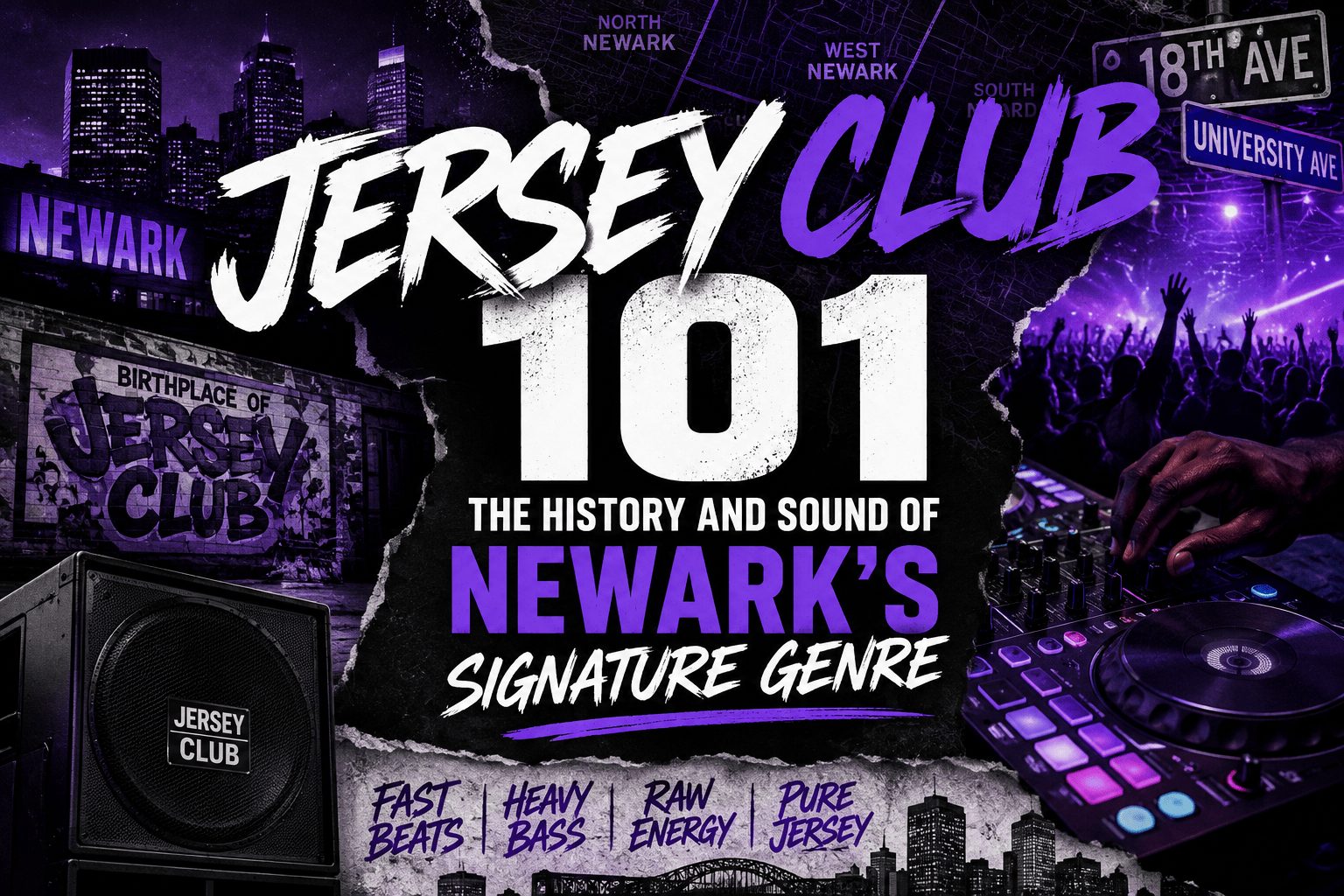
If you have ever heard a DJ drop a track that made the entire room lose their minds before you could even identify the song, there is a good chance you were listening to Jersey Club.
Jersey Club is a percussion-driven, high-energy genre of electronic dance music that originated in Newark, New Jersey in the late 1990s and early 2000s. It is built on chopped vocal samples, propulsive kick patterns, hi-hat rolls, and a tempo that typically runs around 130-140 BPM. When it hits right, it is impossible not to move.
**Where It Came From**
The genre's roots are in the house music and hip-hop culture that defined Newark's club scene for decades. DJs in Newark's underground clubs began developing a distinctive sound — taking elements of Baltimore Club (itself a descendant of Chicago House) and mixing them with hip-hop production sensibilities and a uniquely Jersey energy.
The vocal chopping technique — where vocal samples are cut, reversed, and layered into percussive rhythms — became the genre's most distinctive calling card. A voice becomes a drum. A phrase becomes a groove. The result is something that operates at a different frequency than almost anything else in electronic music.
DJs like DJ Tameil, DJ Smallz 732, Tim Dolla, and others helped develop and popularize the sound through mixtapes, club nights, and early internet distribution, building a genre from the ground up without major label support or mainstream radio play.
**The Sound Defined**
What makes Jersey Club immediately recognizable to anyone who has heard it:
The kick pattern is unconventional. Where most dance music lands the kick on predictable beats, Jersey Club kicks dance around the grid, creating a syncopated energy that keeps the listener slightly off-balance in the best possible way.
The vocal chops are specific. Three-syllable phrases are the genre's lingua franca — "Oh my God," "what happened," "do it" — chopped and looped until the words stop meaning anything and start functioning as pure rhythm.
The energy is relentless. Jersey Club tracks do not build toward a drop in the traditional electronic music sense. The entire track is the drop. There is nowhere to rest.
**How Far It Has Traveled**
Jersey Club is no longer just a Newark phenomenon. The genre has influenced pop production, been sampled by Grammy-winning artists, found dedicated audiences across the globe, and generated academic interest as a case study in how regional music travels through digital networks.
When Cardi B incorporated Jersey Club elements, when global DJs started programming Jersey Club tracks into international sets, when music critics began writing seriously about the genre — Newark DJs were still the ones who invented it, still the ones who live it.
**WAJ Magazine and Jersey Club**
WAJ Magazine has covered Jersey Club artists and culture since our early issues. DJ Smallz 732, one of the genre's key figures, graced the cover of Issue 041. The culture we document and the culture that produced Jersey Club are the same culture — Newark, New Jersey, doing what it has always done: creating something out of nothing and sharing it with the world.
Frequently Asked Questions
What is the most important thing to know about jersey club 101 history sound newark signature genre? This guide covers the key facts, practical information, and resources. See the full guide above for details.
Where can I find more information about this topic? Check the official sources linked throughout this guide for the most current information, and follow We Are Jersey at wajmagazine.com for ongoing New Jersey coverage.
Does this apply across all of New Jersey? Most information applies statewide. Notes are included where local variation by municipality or region is significant.